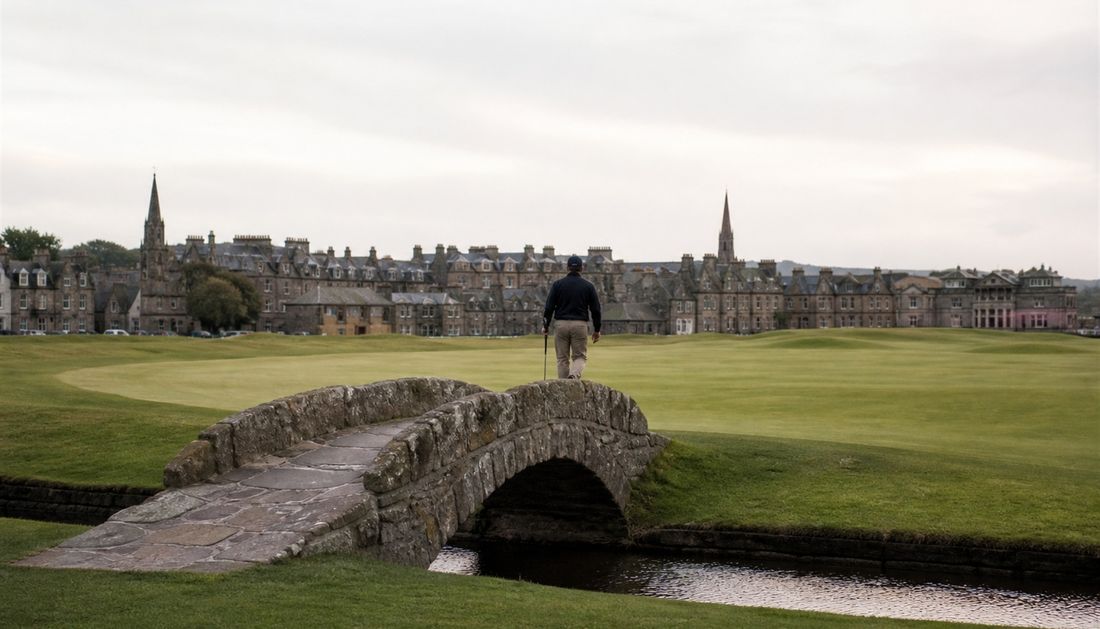
The Open Rota and the Road Hole
The Open is the oldest of golf's four major championships, and it is the only one that moves. It is not attached to a single course, and it is not open to any course that fancies it. Understanding how the rota works, and what makes one hole on one of those courses so consistently punishing, tells you more about links golf than any amount of scenery.
1860, Prestwick, and Twelve Holes
The first Open was played at Prestwick Golf Club on 17 October 1860. Eight professionals played three rounds of Prestwick's twelve-hole course in a single day. Willie Park of Musselburgh beat Old Tom Morris by two shots.
The prize was the Challenge Belt, red Morocco leather with silver buckles and emblems, awarded from 1860 to 1870 on the understanding that three consecutive wins made it the winner's property. Young Tom Morris duly won in 1868, 1869 and 1870 and kept it. There was then no championship at all in 1871, for the straightforward reason that there was no trophy to play for.
The Claret Jug, properly inscribed as The Golf Champion Trophy and made by Mackay Cunningham and Company of Edinburgh, was introduced for the 1872 championship, funded by contributions from the clubs involved. It has been played for ever since.
What the Rota Actually Is
The R&A rotates the championship around a small group of links courses. The current rota is generally listed as nine venues: the Old Course at St Andrews, Carnoustie, Muirfield and Royal Troon in Scotland; Royal Birkdale, Royal Liverpool, Royal Lytham & St Annes and Royal St George's in England; and Royal Portrush in Northern Ireland.
A few points that people get wrong about it. The rota is not a fixed cycle, and venues are not slotted in on a predictable rotation; the R&A typically confirms host courses three to five years ahead. Courses have left the rota and, in Royal Portrush's case, returned to it after a very long absence. And Prestwick, which hosted the first twelve championships, has not staged one since 1925, because the infrastructure a modern Open requires simply cannot be accommodated there.
Confirmed venues at the time of writing include St Andrews in 2027 and Royal Lytham & St Annes in 2028.
The Road Hole
Which brings us to the seventeenth at the Old Course, a par four of 495 yards, and the most examined single hole in championship golf.
The tee shot is blind. Players drive over a replica railway shed attached to the Old Course Hotel, aiming across the corner of the building at a target they cannot see, to a narrow fairway that doglegs right. The traditional line was over one particular letter of the hotel sign. The carry is around 260 yards to safety, and the penalty for over-cutting it is the hotel itself, or out of bounds. Every year, at least one window is at risk.
The green is long, thin and set at an angle across the line of the approach. Short and left is the Road Hole bunker. Long is the road, which is genuinely a road, backed by a low stone wall, and which is in play as a hazard from which the ball must be played.
The Bunker
The Road Hole bunker is small, deep and steep-faced, and it collects anything running towards the green from the left. Players describe it as changing the whole hole: without it, the safe miss short-left would be a routine bogey at worst, and the hole would play perhaps half a shot to three-quarters of a shot easier.
Two episodes have entered the folklore. In 1978 Tommy Nakajima took four attempts to escape it and made a nine. In the final round in 2000 David Duval, in second place at the time, needed four swipes to get out and walked off with a quadruple-bogey eight, finishing eleventh.
The road behind is no kinder. In 1984 Tom Watson, tied for the lead in the final round, drove right onto a mound close to out of bounds, then took too much club with a two iron and went through the green to the wall. He got the ball back across the road but made bogey. Seve Ballesteros birdied the eighteenth minutes later and took the Claret Jug.
The Numbers
The Road Hole's reputation is supported by the scoring, not just by anecdote.
- In the 2015 Open the seventeenth averaged 4.66 strokes, the hardest hole of the week. A bogey there cost Jordan Spieth a place in the play-off.
- Since 1982 it has played as comfortably the toughest hole anywhere on the Open rota, and it accounts for six of the ten most difficult individual holes played at an Open in that period.
- Its differential of plus 0.79 over par in 1984 stands as the highest recorded on any hole at an Open across several decades of scoring records.
- In everyday play from the championship tees it is routinely the hardest hole on the card, with roughly one player in five making par.
Playing It Yourself
The Old Course is a public course, which is the genuinely remarkable thing about all this. It is balloted, it is busy, and it closes on Sundays outside championship weeks, but any golfer with a handicap certificate can put their name in. The seventeenth will still be there, the shed will still be blind, and the sensible plan is the professionals' plan: aim to make four fours over four days and be glad of every one of them.
The Old Course and the rest of the Scottish rota are covered hole by hole in The Great Golf Courses of Scotland, and the English rota venues, along with the heathland and links courses that surround them, in The Great Golf Courses of England.