What Peer-Reviewed Research Actually Says About Esports and the Body
Most writing about esports performance is marketing. Gaming chairs, blue-light glasses and supplements are sold on the promise of an edge, and the evidence behind those promises is usually thin or absent. There is, however, a genuine and growing peer-reviewed literature on what competitive gaming does to the body. It is smaller than the marketing suggests and more useful.
What follows is what that literature currently supports, with the limitations stated rather than glossed over.
The Injury Data
The most substantial recent picture comes from a review of injuries and overuse injuries in esports published in the journal Sports in 2026. It surveyed 1,229 e-athletes across all levels and genres, average age 23.8 years, using a retrospective questionnaire about injuries over the course of their careers.
The headline figures:
- 19.6 injuries and overuse injuries reported per 1,000 gaming hours across the whole group
- Trunk and spine was the most common location, at 26.0 per cent of reported problems
- The wrist region was second, at 18.3 per cent
- Professionals were injured more frequently than amateurs
- Tactical shooter players reported significantly more injuries than sports-game players and MMO players
Two things follow from this. First, the popular image of esports injury as a wrist and hand problem is incomplete — the back and neck are reported more often. Second, this is degenerative and overuse damage, not acute injury. Nobody tears something in a single click.
The honest limitation: this is self-reported and retrospective, so it depends on players remembering and correctly categorising past problems. It tells us where the burden sits. It does not establish cause.
Why a Ten-Minute Break Is Not a Reset
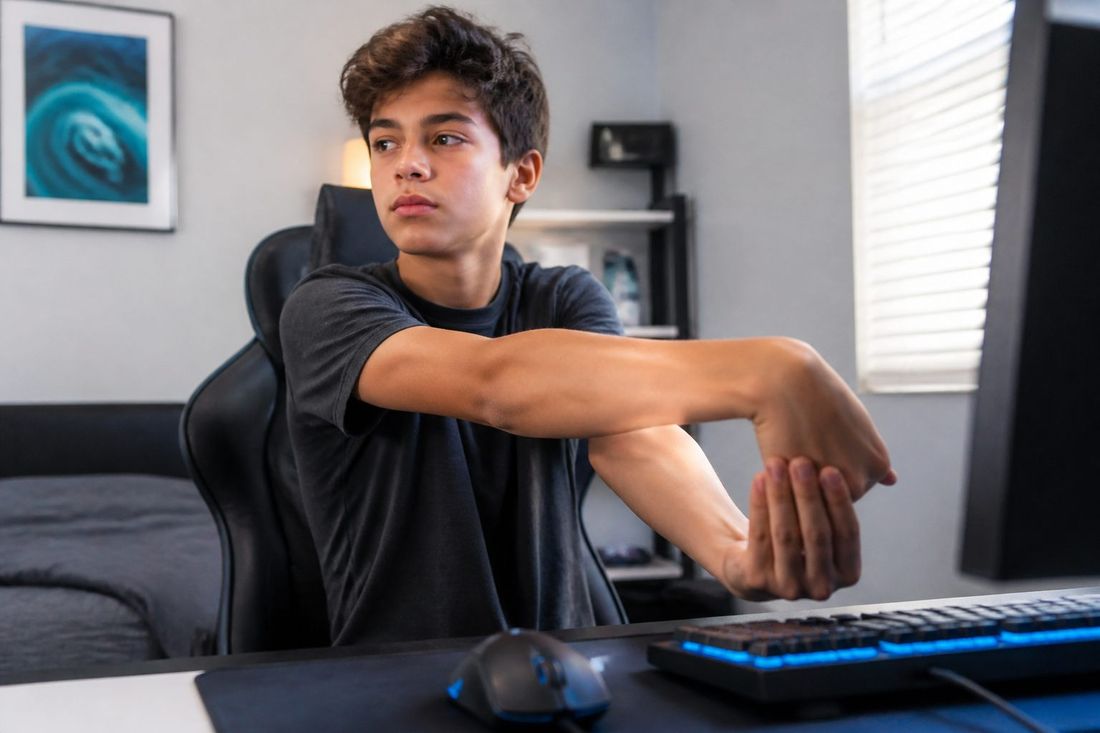
A 2025 study from the German Sport University Cologne, published in BMC Sports Science, Medicine and Rehabilitation, looked directly at wrist extensor fatigue. Thirty-two male esports athletes played two competitive sessions of 90 to 120 minutes, separated by a ten-minute passive sitting break, with muscle activity measured throughout.
Wrist extensor fatigue increased progressively over time. The median frequency of the wrist extensors on both sides fell by around three to four per cent. Critically, there was no neuromuscular recovery across the break — the ten minutes of passive sitting did not return the muscles to where they started, which points toward fatigue accumulating across a long session rather than resetting between games.
Wrist kinematics varied by game genre but did not change with time, which is a useful nuance: how you move your wrist is largely determined by what you are playing, and it stays that way even as the muscle tires. The authors point toward preventive training and regular active breaks rather than passive ones.
Limitations again worth stating: thirty-two participants, all male, one laboratory protocol. It is a well-designed piece of work and it is one study.
Reaction Time: What It Does and Does Not Show
Reaction time is the most-studied cognitive variable in esports and the most over-interpreted. The consistent finding across the literature is that action video game players, esports competitors and traditional athletes tend to have shorter reaction times than non-competitive peers, and electrophysiological work has reported earlier P300 latency in esports players. Studies comparing genres have found first-person shooter players fastest on visual and choice reaction tasks.
What that literature does not settle is direction. Faster people may be drawn to games that reward speed, or the games may train the speed, or both. Cross-sectional comparisons of gamers and non-gamers cannot separate those, and honest papers say so.
The practical implication is one most players get backwards. Raw reaction time has a hard biological ceiling and very limited headroom for training. Anticipation, pattern recognition and decision quality under pressure have far more. If you have time to spend on one, it should not be the stopwatch.
The Caffeine Rules Changing in 2027
Energy drinks sit close to the centre of competitive gaming culture, and the law around them in England is changing.
The UK government has confirmed a ban on the sale of high-caffeine energy drinks to under-16s in England, to be made through secondary legislation under the Food Safety Act 1990. The measures are expected to take effect on 6 April 2027, subject to parliamentary approval. Specifically:
- It applies to drinks containing more than 150mg of caffeine per litre, excluding tea and coffee
- It covers all consumer-facing retailers — supermarkets, convenience stores, restaurants, cafes, online sellers and food delivery businesses
- High-caffeine energy drinks are prohibited entirely from vending machines, with responsibility on whoever controls the premises
- Local authorities enforce it, and businesses breaking the law face fines of up to £2,500
Note the scope carefully: this is England, not the whole of the UK, and it is a confirmed policy with a stated date rather than something already in force. It is worth knowing about in advance if you coach or parent a player under 16, because it will change what is available at events and online.
What Follows From All This
The evidence base supports a short and unglamorous list. Set the desk and chair so the trunk and neck are supported, because that is where the reported burden actually is. Break up long sessions with movement rather than sitting still, because passive rest does not appear to clear accumulated wrist fatigue. Train decision-making and anticipation rather than chasing milliseconds. Treat caffeine as a dose you are managing, not a default input.
None of that sells a product, which is roughly why you do not read it often. The full treatment — ergonomics, injury prevention, reaction time versus anticipation, tilt management, review method and a parent strand that assumes no gaming knowledge — is in Gaming Performance To Succeed, part of the To Succeed series.