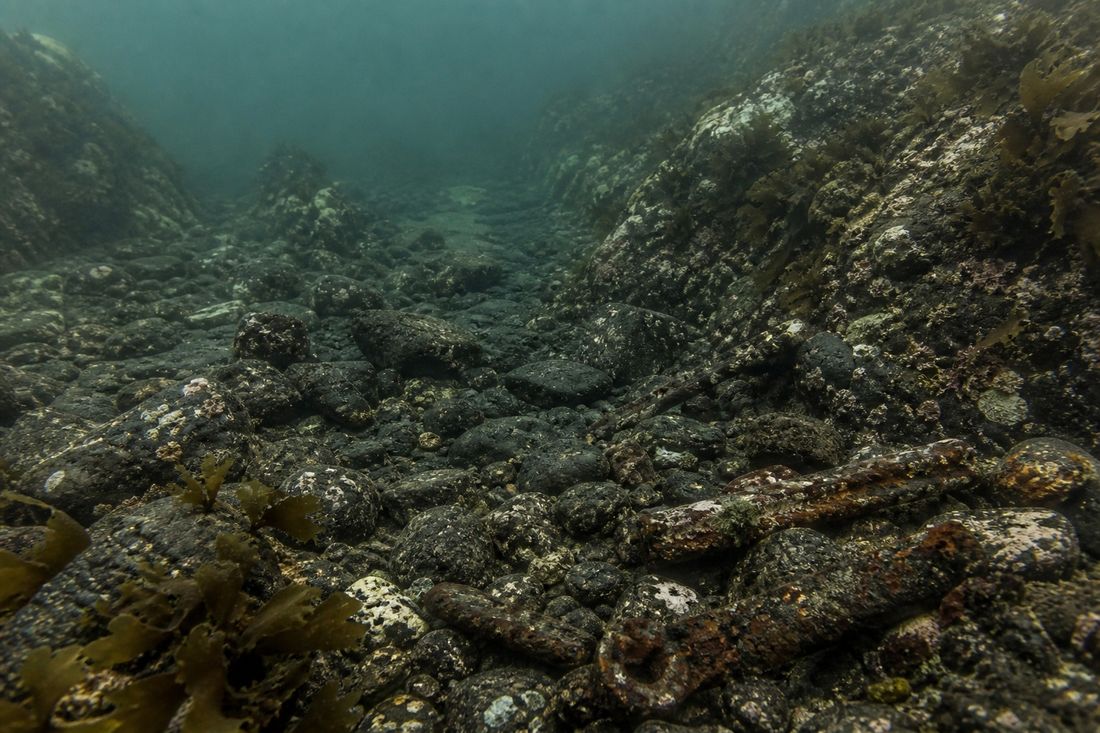
La Girona: The Armada Wreck at Lacada Point
On the night of 26 October 1588, a Spanish galleass called La Girona was driven onto Lacada Point on the north coast of County Antrim, a short distance east of the Giant's Causeway. It remains the single worst loss of life from the Spanish Armada's long, disastrous retreat around Ireland, and the objects recovered from the seabed nearly four centuries later are now among the most significant Armada holdings anywhere.
A Galleass, Not a Galleon
The distinction matters. A galleass carried both sails and banks of oars, a hybrid built for Mediterranean conditions rather than Atlantic gales. She was named for the Girones family, who had recently become Dukes of Osuna and viceroys of Naples, and not, as is often assumed, for the Catalan city. Her captain was Hugo de Moncada y Gralla, a knight of the Order of Malta.
Killybegs, and the Decision to Sail
By the autumn of 1588 the Armada was scattered and broken, working its way home the long way round the top of Scotland and down the west of Ireland. La Girona put into Killybegs harbour in what is now County Donegal with a damaged rudder. She was repaired there with the help of the Irish chieftain MacSweeney Banagh.
On 25 October she sailed for Scotland, badly overloaded with survivors from other wrecked ships, including Alonso Martinez de Leiva, a knight of the Order of Santiago and one of the senior figures of the whole campaign. Contemporary accounts put roughly 1,300 people aboard a vessel never designed to carry anything like that number.
She cleared Lough Foyle, and then a gale caught her. She went onto Lacada Point and the rocks nearby, which have been known ever since as the Spanish Rocks.
How Many Died
Here the sources genuinely do not agree, and it is better to say so than to pick a number and pretend it is settled.
- The number aboard is most often given as about 1,300, though some accounts, including one Northern Ireland government statement, refer to the loss of 1,400 lives.
- The number of survivors is variously reported as three, five or nine. Nine is the figure most commonly cited, but the disagreement is real and long-standing.
- What is consistently recorded is that 260 bodies washed ashore and were buried together in a common grave at the local churchyard.
On any of these figures the survival rate is under one per cent. The survivors were sent on to Scotland by Sorley Boy MacDonnell of Dunluce Castle, which stands on the cliffs a short distance west along the same coast. MacDonnell is also thought to have organised the first quiet salvage attempts on the wreck, within living memory of the sinking.
Sténuit, 1967
The wreck then effectively vanished for close to four hundred years. It was relocated in 1967 by the Belgian diver Robert Sténuit, working with a team that included the underwater cameraman Marc Jasinski and the local diver and historian John MacLennan. Sténuit was already a serious figure in diving history, credited as the world's first aquanaut for his saturation dive work earlier in the decade, and he approached the search as a documentary problem before it was a diving one.
On 27 June 1967 he found lead ingots marked with the Cross of Jerusalem, then a gun, then cannonballs. The team worked the site through to April 1968 off Port na Spaniagh near Portballintrae, and brought up what was at that time the greatest haul of Spanish Armada material ever recovered. Sténuit wrote the story up in Treasures of the Armada, published in 1973.
What Is in the Ulster Museum
The collection is on permanent display at the Ulster Museum in Stranmillis, Belfast, part of National Museums Northern Ireland, and entry is free. It is a genuinely strange and moving group of objects, because so much of it is personal rather than military.
There are gold and silver coins, cannon, armaments and navigational instruments. There is a gold salamander pendant set with rubies, which has become the emblem of the whole collection. There is a lapis lazuli cameo, heavy gold chains of the kind Spanish noblemen wore as portable wealth, and a gold cross belonging to a knight of the Order of Malta, most probably Moncada himself, who was the only such knight aboard. And there is a gold ring engraved with the words no tengo mas que darte, meaning I have nothing more to give you.
The wreck was commemorated for years on the reverse of ten pound notes formerly issued in Northern Ireland by First Trust Bank, which is a quietly appropriate afterlife for a cargo of coins.
The Site Today
Do not plan a dive on it. The site off Lacada Point was designated under the Protection of Wrecks Act on 22 April 1993, and the restricted area extends 300 metres from the designated position. Diving inside that area without a licence is an offence and has led to warnings from the Department for Communities, most recently in connection with both La Girona and the wreck of HMS Drake. Access is managed through a licensing scheme run by the Historic Environment Division.
What you can do is walk the coast above it, stand on the causeway headlands looking down into Port na Spaniagh, and then go to Belfast and look at what came out of it. The two together make more sense than either on its own.
La Girona has a full wreck-story chapter, and the Antrim coast is one of eleven regions covered across the island, Republic and Northern Ireland together, in Scuba Diving Ireland — with honest depth, current and skill ratings, and a plain account of what is legally divable and what is not.