What Sports Science Says About Boxing, and What Ireland's Olympic Record Says About Boxing in Ireland
Boxing is the sport where Ireland has, by some distance, punched above its weight at Olympic level. It is also a sport where a great deal of coaching folklore has survived unexamined. The research on punch mechanics and decision-making is now good enough to test some of that folklore, and the results are not what most gym-floor advice assumes.
The Irish Record, Accurately Stated
Ireland's Olympic boxing history starts in Helsinki in 1952, where John McNally took silver at bantamweight — the first Olympic medal Ireland won in the sport.
The landmark came forty years later. At Barcelona in 1992, Michael Carruth won gold at welterweight, beating Cuba's Juan Hernández Sierra 13-10 on points. It was Ireland's first Olympic gold in any sport since Ronnie Delany's 1500m win in Melbourne in 1956. Wayne McCullough took silver at bantamweight at the same Games.
Katie Taylor won lightweight gold at London 2012, at the first Olympics to include women's boxing. She was beaten on a split decision by Finland's Mira Potkonen at Rio 2016.
Kellie Harrington then won lightweight gold at Tokyo in 2020 and successfully defended it at Paris 2024, beating China's Wenlu Yang 4-1 in the final and becoming the first Irish woman to win gold at consecutive Games.
One figure to be careful with: totals for Ireland's all-time Olympic boxing medal count differ between sources depending on how they are tallied. Team Ireland described Harrington's Paris gold as Ireland's nineteenth Olympic boxing medal; other published counts are lower. The individual results above are not in dispute; the running total is.
A Punch Starts at the Floor
The most useful thing biomechanics has done for boxing coaching is settle where force actually comes from. It is not the arm.
Punching is a kinetic chain: force is generated against the ground by the lower limbs, transferred through the trunk, and delivered at the fist. Studies using force plates to measure ground reaction force alongside sensors measuring punch output consistently find the lower body doing the majority of the work, with published estimates commonly in the region of 60 to 70 per cent of punching force attributable to lower-limb drive. Methods and figures vary between studies, so treat that range as an indication rather than a constant.
The coaching implication is direct. A boxer whose feet are wrong will not fix their power by hitting the bag harder, and arm-focused strength work is a poor use of a junior's limited training time compared with lower-limb and trunk work.
Effective Mass Explains the Jab
Peak force is the number people quote and the least useful one. What matters is how much of the body's mass is behind the strike at impact — effective mass.
Research measuring this has found straight punches, the cross and the jab, carry markedly higher effective mass than hooks, in the region of 30 kilograms for each, despite hooks producing higher peak force readings. Variability between individual boxers in these studies is large, so the figures describe a pattern rather than a target.
That pattern matches what good coaches have always taught by feel: the straight punches are the efficient ones, and a boxer who cannot land a jab has no platform for anything else.
Reaction Time Is Not the Thing
This is the finding that most contradicts common gym practice. A great deal of junior boxing training is built around raw reaction drills, on the assumption that better boxers simply react faster.
The evidence points elsewhere. A systematic review and meta-analysis of perceptual anticipation across combat sports, boxing included, found expert athletes achieved substantially higher response accuracy than non-experts — reported at 83.3 per cent against 68.5 per cent. The advantage came from prediction, not speed: experts read patterns in an opponent's movement and anticipate what is coming, rather than responding faster to the same information.
Eye-tracking work in the same field describes the mechanism. Experts fixate on cues close to the source of the movement, which predict what is about to happen; novices watch the wrong things, generally the glove itself, which arrives too late to be useful.
The training conclusion is uncomfortable for anyone selling reaction-light gadgets. Anticipation is trained against a real opponent producing real, readable movement. It is not trained against a random stimulus, because a random stimulus contains no pattern to learn.
Fatigue Attacks Mechanics and Judgement Separately
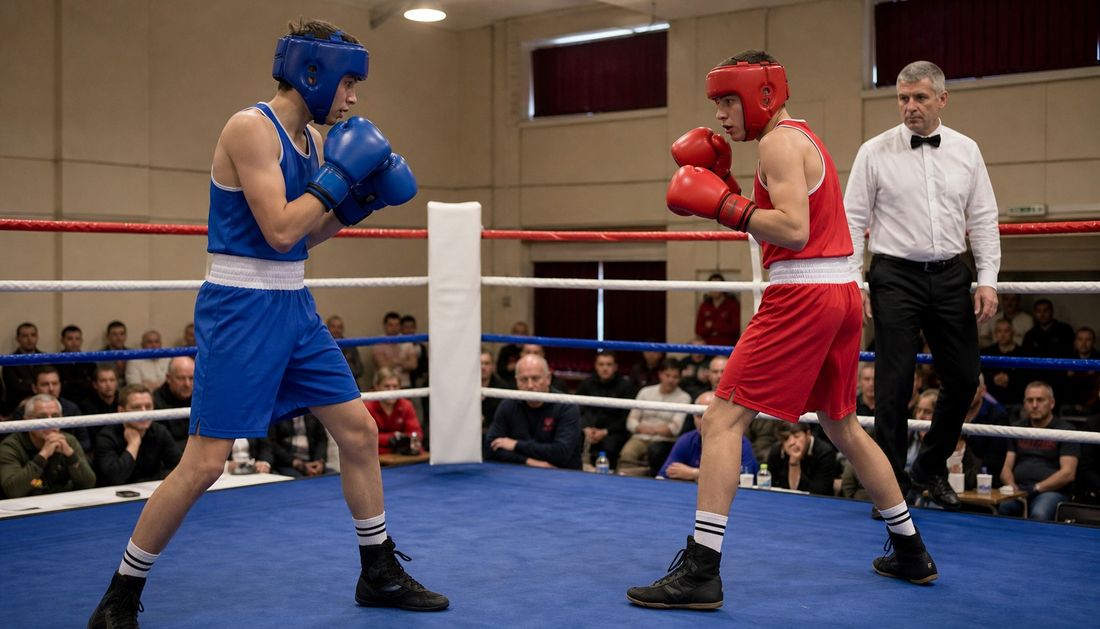
Amateur bouts are three rounds of three minutes, scored by five judges on the ten-point must system. That format puts fatigue at the centre of the sport, and research suggests it degrades two different things.
Biomechanical studies measuring punch force, ground reaction force and rate of force development before and after fatigue protocols show all three falling. The chain breaks down before the boxer stops trying.
Separately, work on mental fatigue and temporal perceptual prediction in boxers found it impaired anticipation across skill levels, with the effect reported as more pronounced on experienced boxers' defensive skills. That is worth sitting with: the boxer whose defence is built on reading the opponent is the boxer with most to lose when concentration goes.
What This Means for a Junior Programme
- Build lower-limb and trunk strength before arm and shoulder work — that is where the force originates
- Prioritise footwork and stance in technical sessions; power follows position
- Train anticipation against a live opponent showing real movement, not against random lights or a random call
- Treat conditioning as a technical issue, not just a fitness one, because mechanics fail before effort does
- Manage mental load in the days before competition, not only physical load
Everything above sits underneath, not instead of, the safety framework a junior boxing programme needs. Stance and footwork, the four punches and the combinations built from them, defensive work, what safe sparring actually looks like at underage level, the IABA and England Boxing amateur pathways, and the safeguarding and concussion protocols are all covered in Boxing To Succeed, part of the To Succeed Sports & Fitness series.