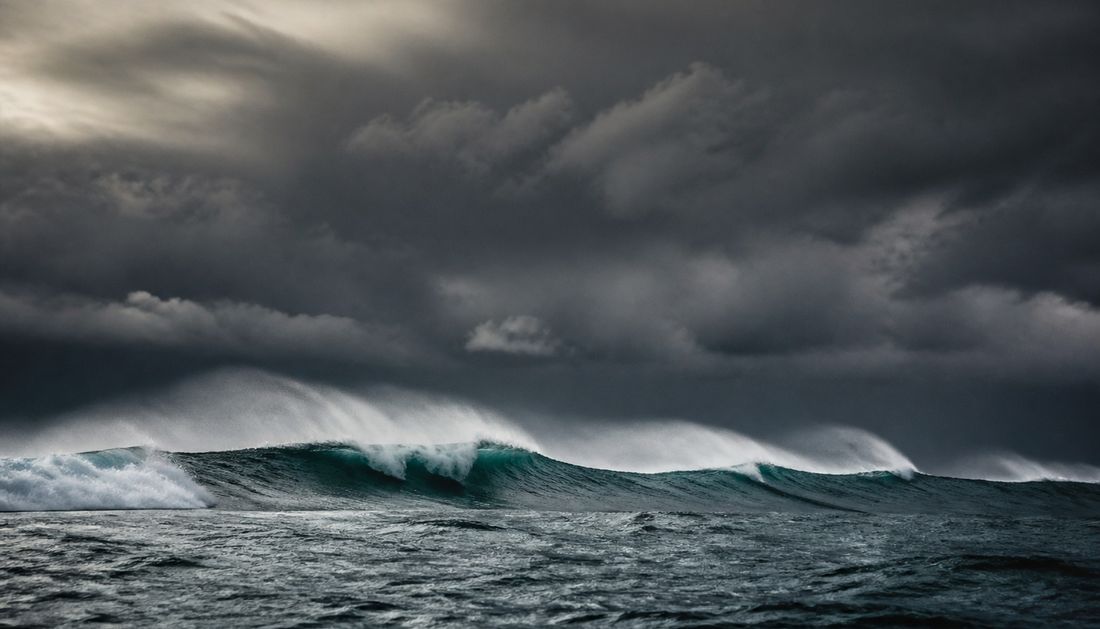
Mullaghmore and Aileen's: The Real Story of Irish Big-Wave Surfing
Ireland has produced two waves that changed how the surfing world thinks about the North Atlantic. One breaks off a headland in County Sligo under a Victorian castle. The other detonates on a reef at the foot of the Cliffs of Moher in County Clare. Both were being ridden well within living memory, and the timeline is short enough that most of the people involved are still around.
Mullaghmore Head
Mullaghmore Head breaks between Grange and Cliffoney, a few hundred metres northwest of Mullaghmore village, facing straight into the North Atlantic. It is a left, long and fast and hollow, running over a shallow reef ledge in front of the headland, with Classiebawn Castle on the skyline behind.
The pioneering work was done by Richie Fitzgerald of Bundoran and the English surfer Gabe Davies, who began working out what the wave could do in the late 1990s. They were among the first in Britain or Ireland to put a jet ski and tow boards together to find out. The wave went international in the middle of the following decade, and Davies and Fitzgerald featured together in Joel Conroy's documentary Waveriders, released in 2009, which did more than anything else to put Irish big-wave surfing in front of a general audience.
Aileen's
Aileen's sits beneath the Cliffs of Moher, roughly halfway between Doolin and Lahinch, in the area known in Irish as Aill na Searrach, the Leap of the Foals. It is a right-hand reef break in an arena of cliffs rising over 200 metres.
By the usual account, the Cornish surf photographer Mickey Smith spotted it in 2004 from the car park at Doolin Point during a large swell, and walked the cliff line with a group of bodyboarders to look at it properly. The Irish surfer John McCarthy and Dave Blount rode it first in October 2005. Note that Blount's surname appears as Blunt in several published accounts; the spelling is not settled across sources, which is worth flagging rather than quietly picking one. Easkey Britton is widely reported as the first woman to surf it, at the age of 21.
What Makes Them Break
Neither wave is remotely reliable, and both need a specific combination rather than simply a big forecast.
- Mullaghmore wants a west to northwest Atlantic groundswell with a southeast wind holding it up. It needs size and a high tide to break properly out from the rock. Winter is the season and January is the classic month.
- Aileen's wants a west-southwest swell with a light easterly offshore. It works across the tide range. Spring, and April in particular, is when those conditions line up most often on that stretch of the Clare coast.
Both are approached by jet ski as often as not. The walk-in option at Aileen's is a thirty-minute descent of a narrow track to boulders, followed by a long paddle. This is not a spot you wander into.
About Those Wave Heights
Be sceptical of the numbers, including ours. Big-wave heights are almost never measured. They are estimated from photographs and video, and different traditions measure differently, some from the back of the wave and some from the face. That is why the same session can be reported at wildly different sizes.
Two figures are widely repeated and worth handling carefully. Aileen's is commonly described as capable of reaching around 50 feet, and as paddleable up to roughly 25 feet, beyond which towing is the only sensible option. At Mullaghmore, the late October 2020 swell generated by the remnants of Hurricane Epsilon merging with a mid-latitude depression is generally reported at around 60 feet, and Conor Maguire's ride from 28 October that year was widely described as the biggest wave ever surfed in Ireland and nominated for Biggest Tow at the following year's Red Bull Big Wave Awards. Those are the reported figures, consistently repeated. They are not survey data, and anyone who tells you a precise number for a wave face is telling you an estimate.
The Danger Is Not Rhetorical
Mullaghmore has broken vertebrae and ribs and has put lives in genuine jeopardy. Jet skis have been swept away on the heaviest days. Inflatable flotation vests are treated as mandatory there, and they do not make it safe, they make it survivable more often. The Irish Tow Surf Rescue Club, co-founded by the Dublin firefighter and big-wave surfer Peter Conroy, exists precisely because the water safety problem at these spots outgrew the informal arrangements that came before it.
Documented injuries on this coast include Conroy's own broken back, sustained in 2009 not at Mullaghmore but at Riley's, another Clare slab, where a rescue sled doubled as a spinal board. The Australian bodyboarder Ben Player ruptured his spleen on the same reef. Broken backs, dislocated shoulders, flipped boats and near drownings all appear in first-hand accounts from the past two decades. At Aileen's the Irish Coast Guard has carried out several search and rescue operations in a location that is genuinely difficult to reach, and helicopter extraction from the base of the Cliffs of Moher has happened more than once.
Watching, Not Surfing
For almost everybody reading this, the correct plan is to watch. Both waves reward spectators: Mullaghmore from the headland road, Aileen's from the cliff path above, where the scale of the thing is far more legible than it is from the water. Check the forecast, dress for an Atlantic winter, stay well back from cliff edges in wind, and accept that the odds of the wave performing on the weekend you happen to be there are low.
Both breaks are covered in full, with swell, wind, tide, season and an honest skill rating, alongside 35 other named breaks across six regions, in The Great Surf Breaks of Ireland.