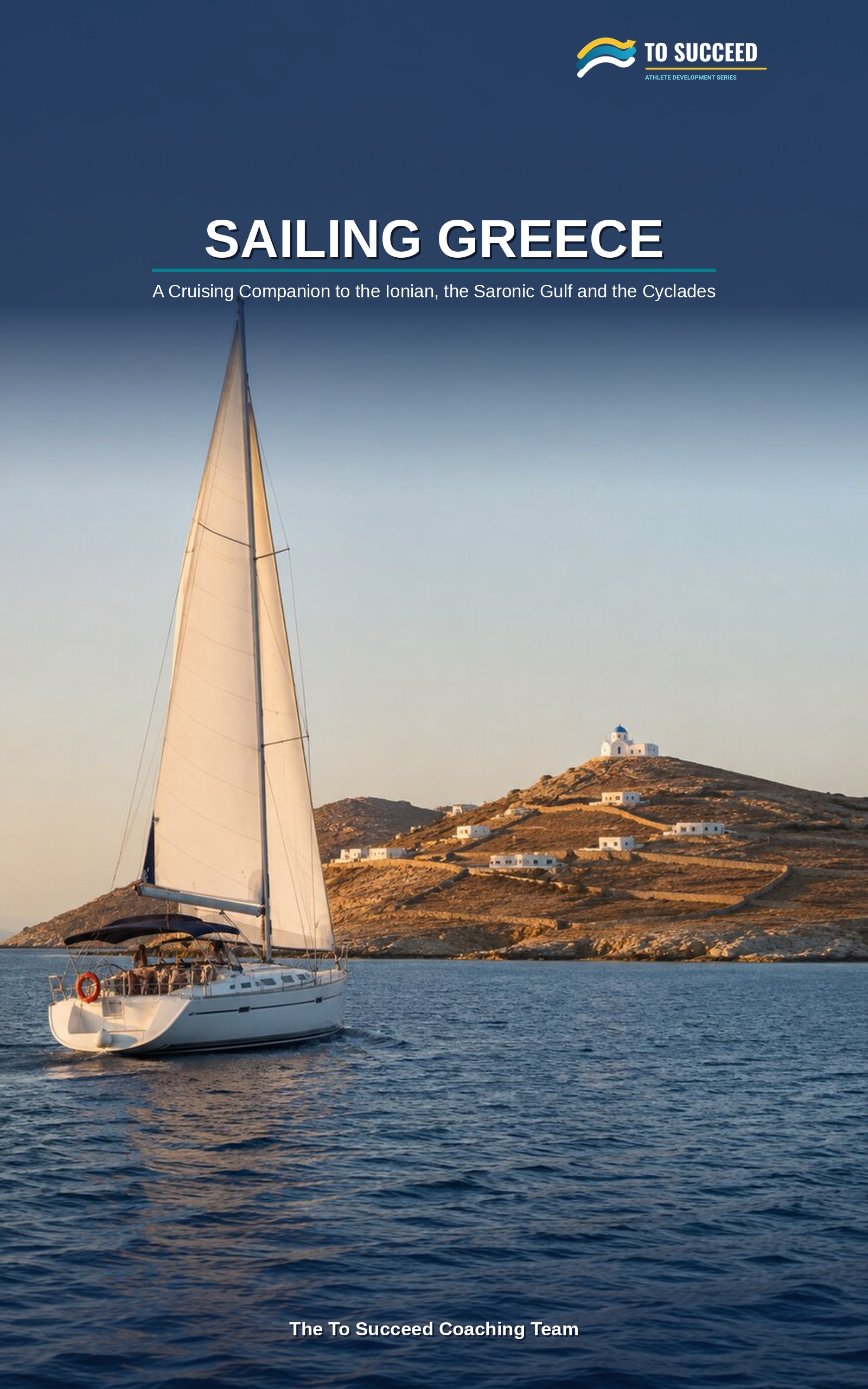
Sailing Greece: A Cruising Companion for the Ionian, the Saronic Gulf and the Cyclades
Sailing Greece is the eleventh title in our Travel Guides series, and the first built for people planning a charter rather than a round of golf, a dive or a road trip. It covers three cruising grounds — the Ionian, the Saronic and Argolic Gulfs, and the Cyclades — the three grounds the overwhelming majority of visiting sailors actually charter in. The Sporades, the Dodecanese, the Eastern and Northern Aegean and Crete are deliberately left out, and flagged in the book's closing section as a possible second volume rather than squeezed in and thinned out.
Matched to Your Crew
A pilot book tells you a harbour exists and what the seabed is made of. A brochure tells you it is beautiful. Sailing Greece is written to sit alongside both, not replace either, and to add the layer neither carries: which ground actually suits which crew. Bareboat, flotilla or skippered charters get a straight answer on which of the three grounds genuinely suits a first Greek week — and which doesn't, whatever the brochure photos suggest.
Honest About the Meltemi
The book states the Cyclades' summer meltemi plainly, including the conclusion that a first-time bareboat crew should not plan a July or August Cyclades trip. That is not the easiest thing for a guidebook covering a popular cruising ground to say, but it is the honest one, and it is consistent with how every title in this Travel Guides series is written — say where the real difficulties are, rather than smoothing them over for a better sales pitch.
The Practical Layer
Beyond the anchorages and the harbours, the book covers the mechanics of an actual charter week: the Mediterranean moor, long-lining ashore, provisioning, the Lefkas canal bridge, and the paperwork — including the e-Charterparty that became mandatory on 1 July 2026. Four core worked itineraries are given in full, with variants and a fifth route, plus a bolt-hole table for the days the forecast changes and the plan has to.
No Invented Prices, No Invented Quotes
Two things are deliberately absent. There are no reader quotes, no testimonials and no unattributed local wisdom anywhere in the book — every title in this catalogue holds to that rule, and Sailing Greece was checked specifically for it. And there are no prices: charter rates, deposits, berthing charges and the cruising fee all move, and a wrong figure in a guidebook is worse than no figure at all, because a reader plans around it. What the book gives instead is the structure of each charge — who levies it, what triggers it, and what to confirm in writing before you fly.
Where the Sources Disagree
Where two reputable sources genuinely disagree — about the shelter at Vourkari on Kea, about the main harbour on Aegina, about whether Parikia is good meltemi shelter or a surge trap — the book prints both positions and tells the reader to check the chart, rather than picking one silently and sounding more confident than the evidence allows.
Sailing Greece joins golf in Ireland, Scotland and England, surfing in Ireland and England, climbing in Ireland, Scotland and the UK, diving in Ireland, and campervan touring on the Wild Atlantic Way as the eleventh book in our Travel Guides series.